
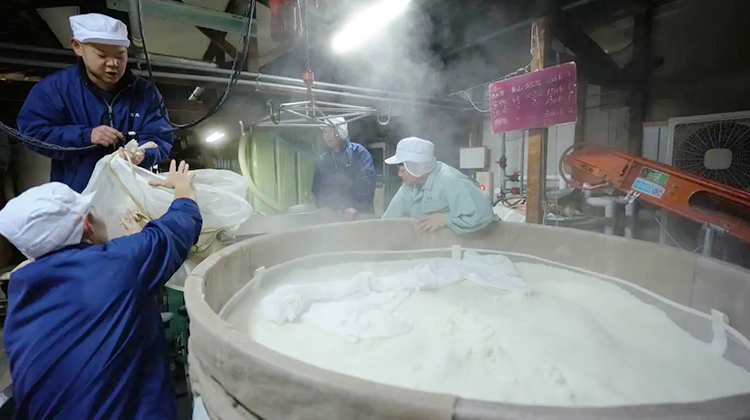
Not long after dawn, Japanese sake brewer Mie Takahashi checks the temperature of the mixture fermenting at her family's 150-year-old sake brewery, Koten, nestled in the foothills of the Japanese Alps.
天刚刚亮的时候,日本酿酒师高桥美绘正在确认发酵中的混合酒液的温度,这些酒液存放在高桥家族 150 年历史的清酒酒厂——高天,坐落于日本阿尔卑斯山边的小丘中。
"The morning hours are crucial in sake making, " said Takahashi, 43. Her brewery is in Nagano prefecture, a region known for its sake making.
“清晨的时间对于制酒来说至关重要。”43 岁的高桥说道。她的酒厂位于长野县,一个以制酒闻名的地区。
Takahashi is one of a small group of female toji, or master sake brewers. Only 33 female toji are registered in Japan's Toji Guild Association out of more than a thousand breweries nationwide.
高桥是女性“杜氏”(也就是日本清酒酿酒大师)这个小群体中的一员。日本全国有一千多家酿酒厂,而在杜氏协会中注册的酿酒师中仅有 33 名是女性。
That's more than several decades ago. Women were largely excluded from sake production until after World War II.
但相比几十年前,33 人已经算多了。一直到二战结束之前,女性基本被排除在制造清酒的工作之外。
Sake making has a history of more than a thousand years, with strong roots in Japan's traditional Shinto religion.
清酒酿造有一千多年的历史,与日本传统的神道宗教有着密不可分的关系。
But when the liquor began to be mass produced during the Edo period, from 1603 until 1868, an unspoken rule barred women from breweries.
然而,当酒开始在江户时代(1603-1868年)批量生产时,一条不成文的规定将女性拦在了酒厂之外。
The reasons behind the ban remain obscure. One theory is that women were considered impure because of menstruation and were therefore excluded from sacred spaces, said Yasuyuki Kishi, vice director of the Sakeology Center at Niigata University.
禁令背后的原因依然不为人知。有一种说法是,在当时,女性由于月经被认为是不洁的,因此被“圣地”拒之门外,新泻大学清酒研究中心副主任岸保行介绍道。
"Another theory is that as sake became mass produced, a lot of heavy labor and dangerous tasks were involved, " he said. "So the job was seen as inappropriate for women."
“另一种说法是,由于清酒量产涉及到了很多重体力劳动和危险作业。”他说道,“因此这项工作被认为不适合女性。”
But the gradual breakdown of gender barriers, coupled with a shrinking workforce caused by Japan's fast-aging population, has created space for more women to work in sake production.
但是性别壁垒的逐步瓦解以及日本人口快速老龄化带来的劳动力缩减,都为女性在制酒业工作制造了空间。
The inclusion of women plays an important role in the survival of the Japanese sake industry, which has seen a steady decline since its peak in the 1970s.
日本清酒业自 1970 年代的高峰以来,一直在持续衰退,女性的加入对清酒业的生存起到了重要的作用。
"It's still mostly a male-dominated industry. But I think now people focus on whether someone has the passion to do it, regardless of gender, " Takahashi said.
高桥表示:“制酒依然是一个几乎由男性主导的行当,但我觉得现在人们更关注一个人是否有热情从事酿酒,不分性别。”